
Test scope, screenshots, checkpoint findings and tier rationale were supplied by an identified reviewer. Identity is retained internally unless public attribution is explicitly enabled.

AI · South AfricaFull evidence record
Enclave AI
Enclave is a sovereign enterprise AI knowledge-retrieval product designed to deploy inside a customer-controlled cloud environment and connect internal sources such as Slack, Drive, GitHub, Confluence and Jira.
Sandbox Africa checked the submitted evidence and promoted the verified checkpoint record. Any visible adjustment is identified rather than silently rewritten.
The official public tier and technical record below are the verified publication outcome.
Tier 1 — Functional MVP
Keep Tier 1. There is credible product and architecture evidence beyond a concept, but current design-partner access and vendor-controlled demonstrations do not establish a independently verified market-ready deployment.
Strongest supporting evidence
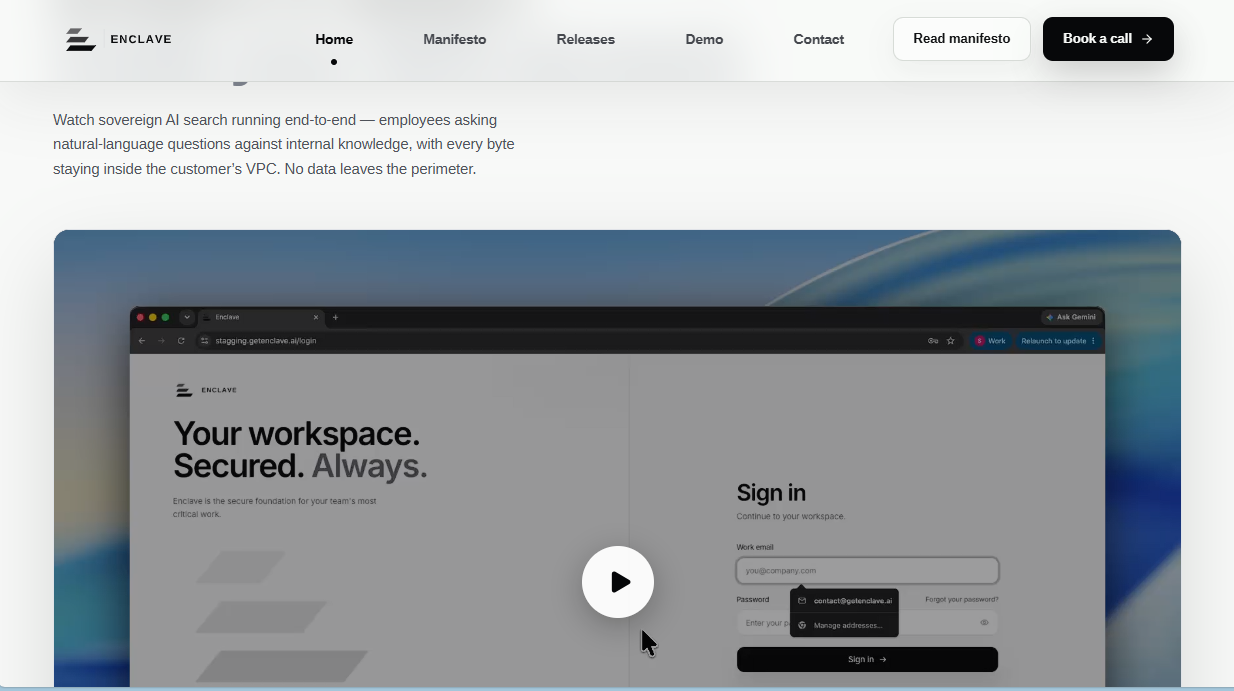
The demo page shows a video demonstration of the product functioning, distinguishing this from a pure landing page with no evidence of a working product. The site provides a specific, technically detailed architecture description — VPC deployment, KMS key exclusion, CloudTrail audit logging — rather than generic marketing language. The company is confirmed as a real, currently operating South African entity (Enclave Labs Inc, Cape Town, founded 2026) via independent listing. A valid, currently active TLS certificate was independently verified.
Why the next tier is not yet supported
Tier 2 requires a stable, usable product with basic integrations demonstrated for standard adoption. This cannot be shown: there is no self-serve access, no independently operated demo, and no published API or integration documentation for any of the five named connectors. All core loop evidence is a single vendor-controlled video rather than analyst-directed testing, so stability and usability cannot be assessed at all, let alone confirmed as market-ready
Verified findings and limitations
Direct review observations
The intern reviewed the public architecture, security disclosures and recorded product demonstration but could not create an account or operate the product. Access was limited to a design-partner call or direct contact.
Independent verification
The current official site describes deployment inside the customer AWS account with customer-owned storage, keys and audit logs. Its manifesto states that the first version is for design partners, and the company says SOC 2 Type II verification is still in progress.
Observed issues
No self-service environment, public API reference or independently operated integration workflow was available.
Testing limitations
Core product behaviour, usability, performance and security controls could not be independently exercised inside a customer cloud.
What was actually assessed
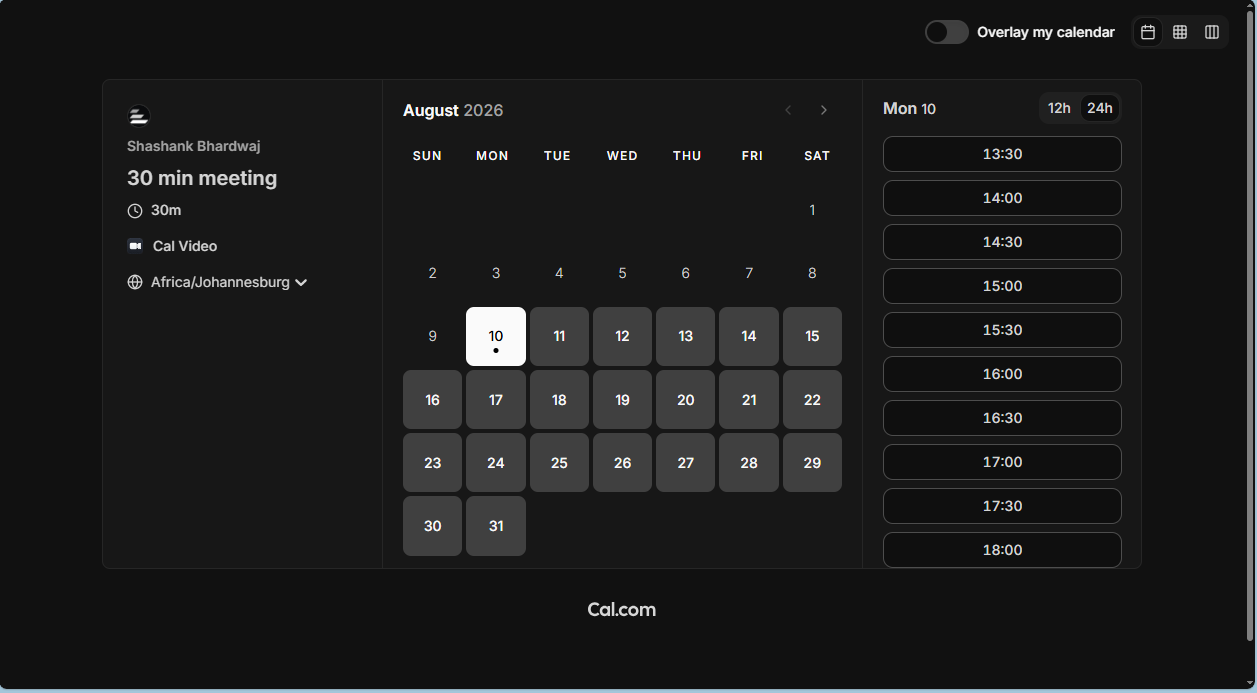
Reviewed the marketing site at getenclave.ai in full, covering Home, Manifesto, Releases, Demo and Contact pages. Verified the TLS certificate via direct browser inspection. Searched independently for company identity and origin, confirming Enclave Labs Inc as a Cape Town-based entity founded in 2026 via a third-party business listing, since this was not stated on the primary site. Watched the video demonstration on the Demo page as the primary source of core-loop evidence. Attempted to locate a self-serve trial, sandbox or API reference; none exists — the only entry points are a design-partner call booking (via Cal.com) and a direct email contact. No account could be created and no product interface was directly accessed.
Environment / device / browser
Edge on Windows
Account or access type
Business account
Access limitations
No self-serve product access exists. The only entry points are booking a design-partner call or emailing the company directly, so the core loop, UX/UI and performance could not be independently tested. Core loop evidence is limited to a recorded demo video, which is vendor-controlled and shows a pre-selected example rather than analyst-directed testing. No API reference, webhook documentation or technical integration guide is published for the named integrations (Slack, Drive, GitHub, Confluence, Jira). Security architecture claims are partially self-attested by the company's own disclosure, with SOC 2 Type II stated as in progress rather than complete — this is the vendor's own framing, not a gap this analyst identified independently.
What was observed
These images formed part of the evidence pack considered during verification. Full-standard records retain the contributor's factual caption for each screenshot.
Seven checkpoint assessment
The verified result is the official public checkpoint record. For earlier-standard reviews, these findings may have been reconstructed from preserved evidence during Sandbox Africa’s 2026 audit; they are not presented as if the contributor originally completed a structured worksheet. Contributor-submitted checkpoint wording is shown only where explicit public reviewer attribution has been enabled.
Step 1 — The Existence & Accessibility Check
Is it live?
Checking for dead links, infinite loading screens, or "Coming Soon" landing pages masquerading as live products.
Sandbox verifiedpass
The marketing site at getenclave.ai loads fully with no dead links or rendering faults across Home, Manifesto, Releases, Demo and Contact pages. This is a "Pass" on the marketing site only — there is no product to assess as live or inaccessible, since none exists for public access at this stage.
Onboarding friction
Can a user or enterprise actually sign up, or is it gated behind broken "Contact Sales" forms?
Sandbox verifiedpartial
No self-serve registration, trial or demo access exists. The only entry points are booking a design-partner call via Cal.com or emailing contact@getenclave.ai. No account can be created, and no product can be entered without a completed sales/partnership conversation Editorial proposal adjusted from fail to partial using current independent verification and the established gated-product/safety-critical rules.
Verification adjustmentStep 2 — Functional Testing (The "Try It Out" Phase)
Core loop execution
Does the application actually do what it claims to do? (e.g. a payment gateway completing a test transaction, a logistics app's routing engine working.)
Sandbox verifiedpartial
The core loop — deploying inside a customer's AWS account, connecting data sources, and returning a sourced, permission-aware answer — requires infrastructure (a company AWS account, internal data sources) that cannot be replicated by an independent evaluator. No sandbox or demo environment is available to test any part of this workflow directly. Editorial proposal adjusted from not_assessed to partial using current independent verification and the established gated-product/safety-critical rules.
Verification adjustmentUser experience (UX) & interface (UI)
Assessing the logical flow, responsiveness, and basic accessibility of the platform.
Sandbox verifiedpartial
No product interface is accessible. Only the marketing site's UX could be observed, which is not a substitute for assessing the actual product interface an employee would use to query the system. Editorial proposal adjusted from not_assessed to partial using current independent verification and the established gated-product/safety-critical rules.
Verification adjustmentStep 3 — Technical & Architectural Assessment
Performance
Load speeds, uptime reliability, and basic stress responses.
Sandbox verifiedpartial
No product was assessed so unable to check the performance Editorial proposal adjusted from not_assessed to partial using current independent verification and the established gated-product/safety-critical rules.
Verification adjustmentIntegration readiness
Availability, clarity, and functionality of API documentation and webhooks.
Sandbox verifiedpartial
Specific claimed integrations are named — Slack, Google Drive, GitHub, Confluence and Jira — and the architecture description explains at a conceptual level how connection and permission-checking work. However, no API documentation, webhook reference or technical integration guide is published; the claims are descriptive rather than documentation an engineer could act on.
Security basics
SSL certification, basic encryption standards, and data handling transparency.
Sandbox verifiedpartial
HTTPS confirmed via a valid, currently active Let's Encrypt certificate (domain-validated, issued 22 July 2026, expiring 20 October 2026). The site also provides an unusually detailed security architecture description — VPC deployment, KMS key policy exclusion, full CloudTrail audit logging — and explicitly distinguishes verifiable infrastructure claims from self-attested conduct claims, with SOC 2 Type II stated as in progress. Marked Partial rather than Pass because none of the architectural claims beyond basic site TLS could be independently verified — they describe the product as designed, not as observed in operation.
Company right of reply
Claim company profile
Represent Enclave AI?
Claiming verifies company ownership and enables a response or additional evidence. It does not permit editing of the independent review.