
Test scope, screenshots, checkpoint findings and tier rationale were supplied by an identified reviewer. Identity is retained internally unless public attribution is explicitly enabled.
Civic Infrastructure — Electricity & Water Smart Metering, Billing & Revenue Assurance · South AfricaFull evidence record
Meerkat Energy / Meerkat Utilities
Meerkat provides smart utility metering, billing, revenue-assurance and customer energy-insight services for utilities, property operators and end users.
Sandbox Africa checked the submitted evidence and promoted the verified checkpoint record. Any visible adjustment is identified rather than silently rewritten.
The official public tier and technical record below are the verified publication outcome.
Tier 2 — Market-Ready
Verified tier differs from submissionUpgrade to Tier 2. Direct backend-backed customer functionality plus current enterprise utility operations support market readiness; Tier 3 is not established without a real metering/billing integration and governance assessment.
Strongest supporting evidence
The clearest positive evidence is the meter-search function correctly rejecting an unknown meter number with a specific, real error message, and the forgot-password flow's identical response regardless of account existence — both indicate a real, properly engineered backend rather than a superficial front end. The fact that an unaffiliated tester could reach and complete the Energy Insight registration flow at all (unlike the fully sales-gated corporate site) is itself strong evidence of a genuine, testable core product.
Why the next tier is not yet supported
Tier 2 is not yet supported because the registration form's front-end validation is unreliable: invalid email and phone inputs are silently rejected with zero user-facing feedback, leaving the user to guess what's wrong. Additionally, the meter-number field is visually marked mandatory but is not actually enforced, meaning the interface misrepresents its own requirements. Until input validation is consistent and self-explanatory across every step — matching the real rigor already present in the backend meter-lookup system — the platform can't be confirmed as the polished, self-explanatory UX Tier 2 requires.
Verified findings and limitations
Direct review observations
The intern tested the corporate site and customer-facing Energy Insight experience. Self-service registration reached meter setup, and an unknown meter identifier produced a specific backend validation response. The corporate operating platform remained sales-gated.
Independent verification
The current official site describes smart-meter data ingestion, end-to-end utility billing, revenue-assurance operations, consulting and field services, corroborating an actively marketed operational utility platform.
Observed issues
Consumer onboarding gave weak feedback for invalid contact data, and a meter field marked mandatory could be skipped.
Testing limitations
No real customer meter, billing cycle, payment flow or enterprise administration environment was available for the review.
Independent verification sources. Source 1
What was actually assessed
Tested two connected surfaces of the Meerkat product family: the corporate/sales site (meerkatenergy.co.za) and the customer-facing 'Energy Insight' mobile app (meerkatutilities.co.za). Sequence: blank-login validation check, forgot-password test with a non-existent-style email, 'Book a demo' form tested both incomplete and complete, back-button data-persistence check, then on the app: registration with invalid dummy inputs followed by correction to valid data, skipping the 'mandatory' meter field, and searching both a placeholder and random meter number. Out of scope: full account activation on the corporate site (blocked by sales gate) and any billing/payment functionality
Environment / device / browser
Android mobile device, native Chrome browser plus the 'Energy Insight' native app installed directly on-device. Standard mobile data / Wi-Fi connection
Account or access type
New public account
Access limitations
Could not access or verify the corporate site's core metering/billing product, as it's fully gated behind a sales-led demo request with no self-serve or sandbox option. On the app, no active/paid account or real customer meter was available, so consumption monitoring and billing features beyond initial setup remain untested
What was observed
These images formed part of the evidence pack considered during verification. Full-standard records retain the contributor's factual caption for each screenshot.
Evidence 1
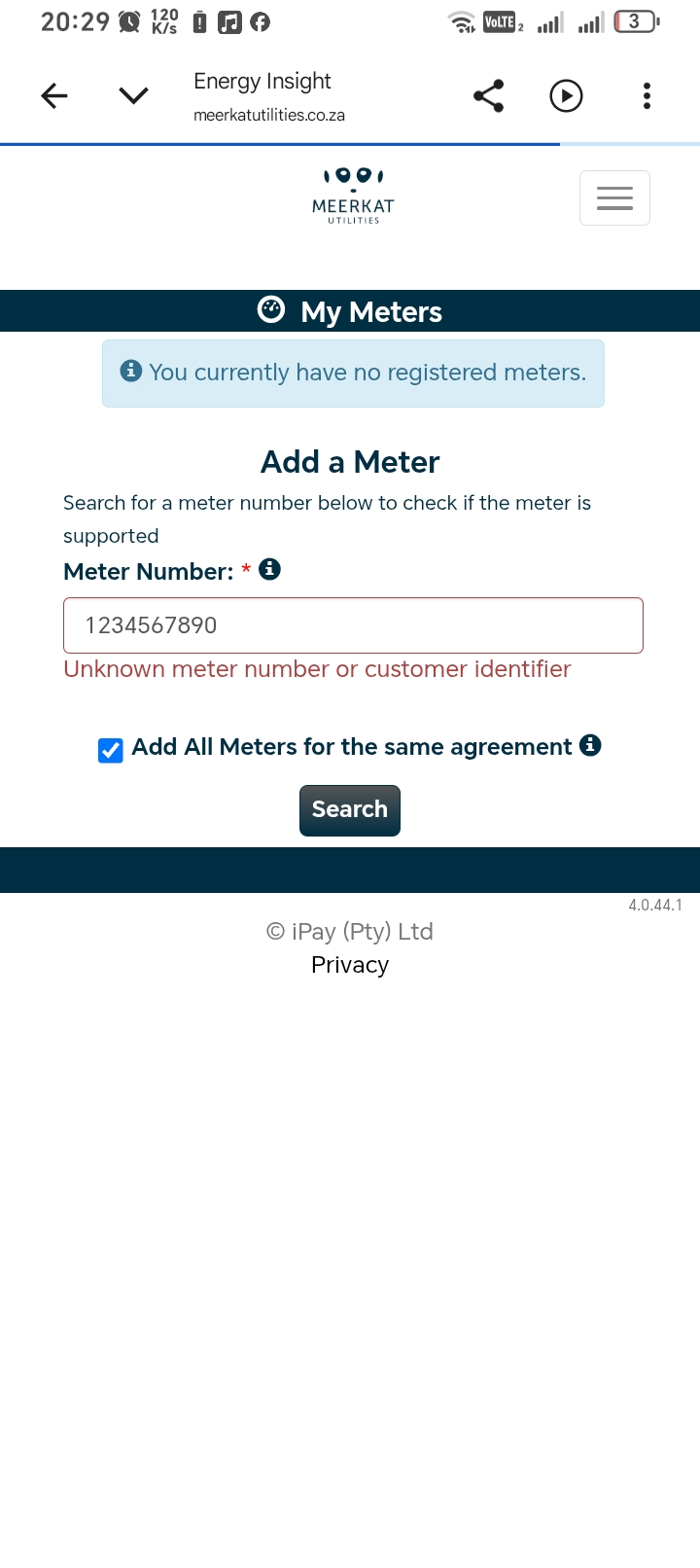
Energy Insight' app — 'My Meters' screen; searching a test meter number (1234567890) correctly returns 'Unknown meter number or customer identifier.' Supports the finding that the app's backend performs genuine server-side meter validation
Evidence 2
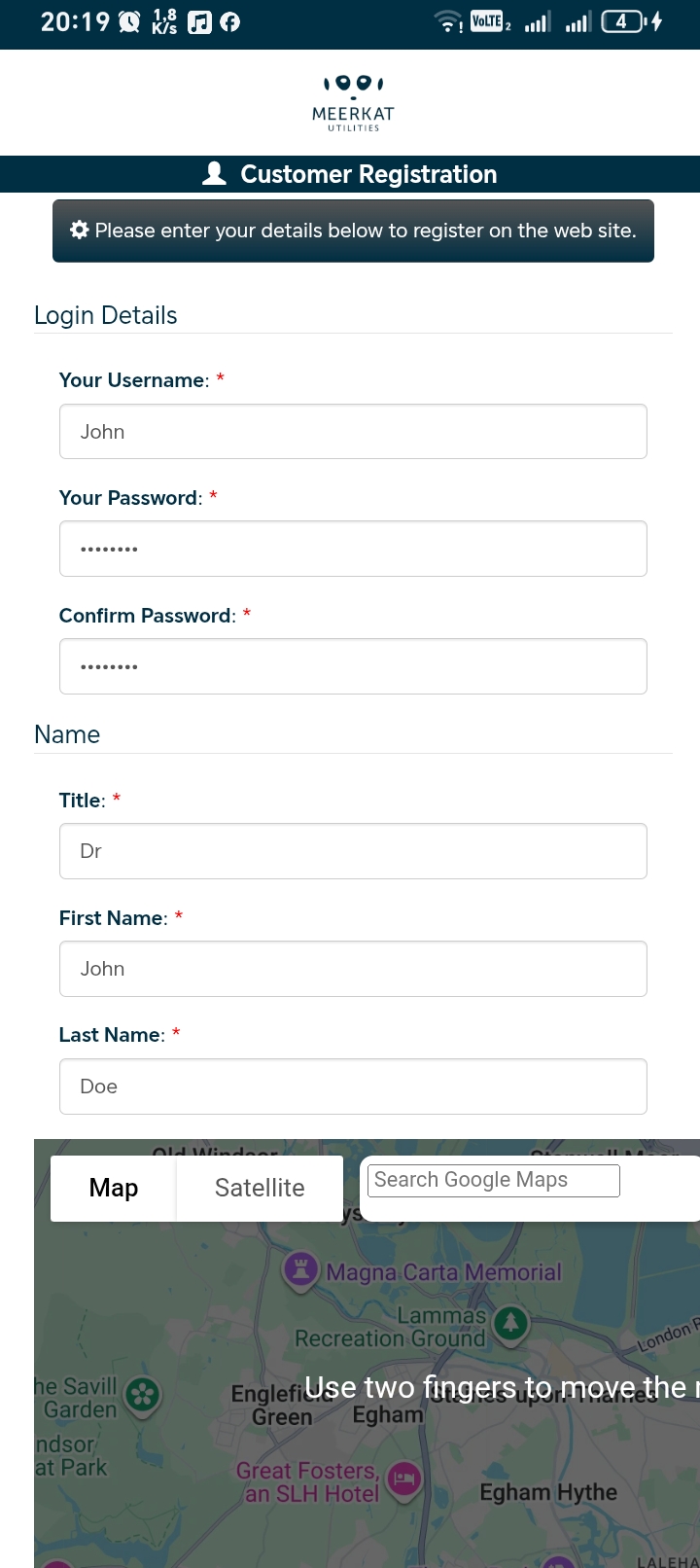
Customer Registration form completed with valid test data (username, password, title, first/last name) plus an embedded Google Map for address selection. Supports the finding that the app offers genuine self-serve registration, distinct from the sales-gated corporate site
Evidence 3
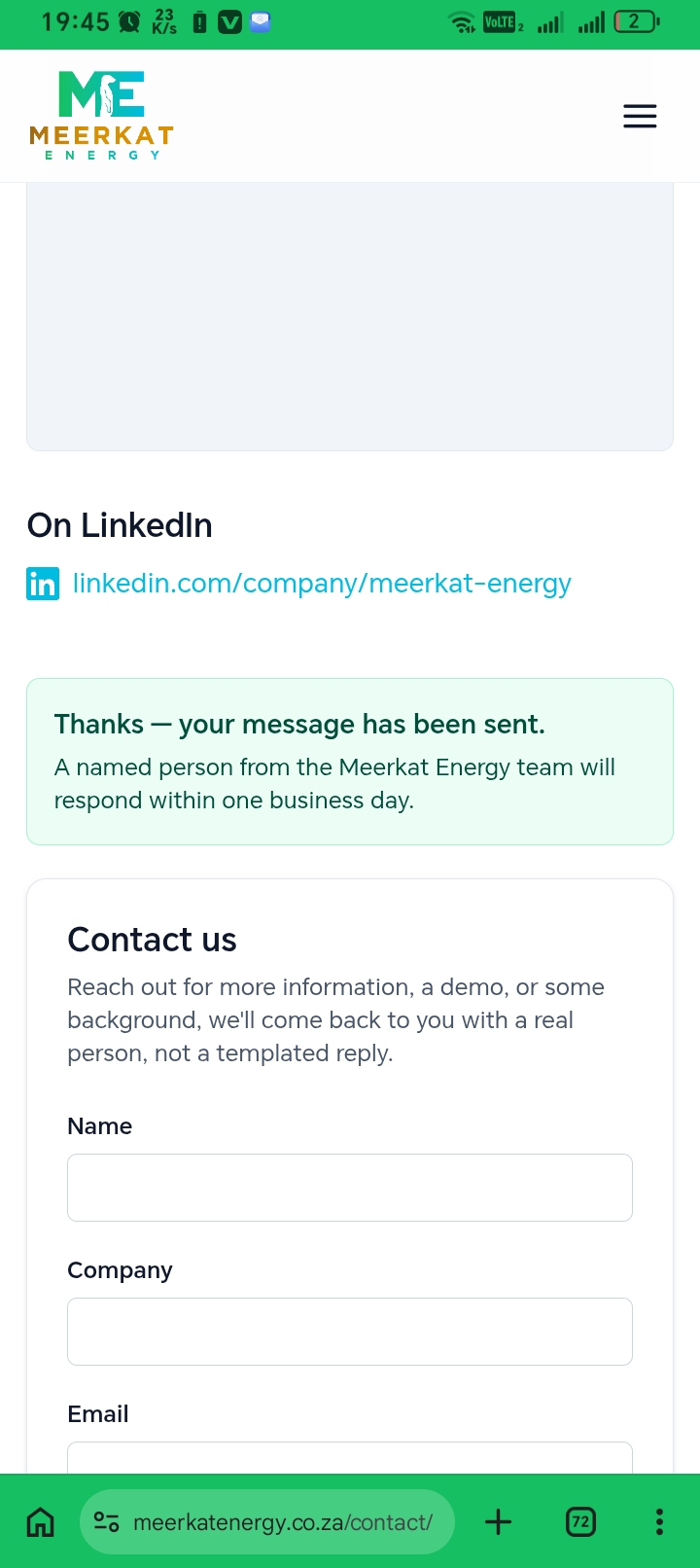
post-submission confirmation, 'Thanks — your message has been sent,' committing to a named-person response within one business day. Supports the finding that the sales-led onboarding funnel functions correctly end-to-end
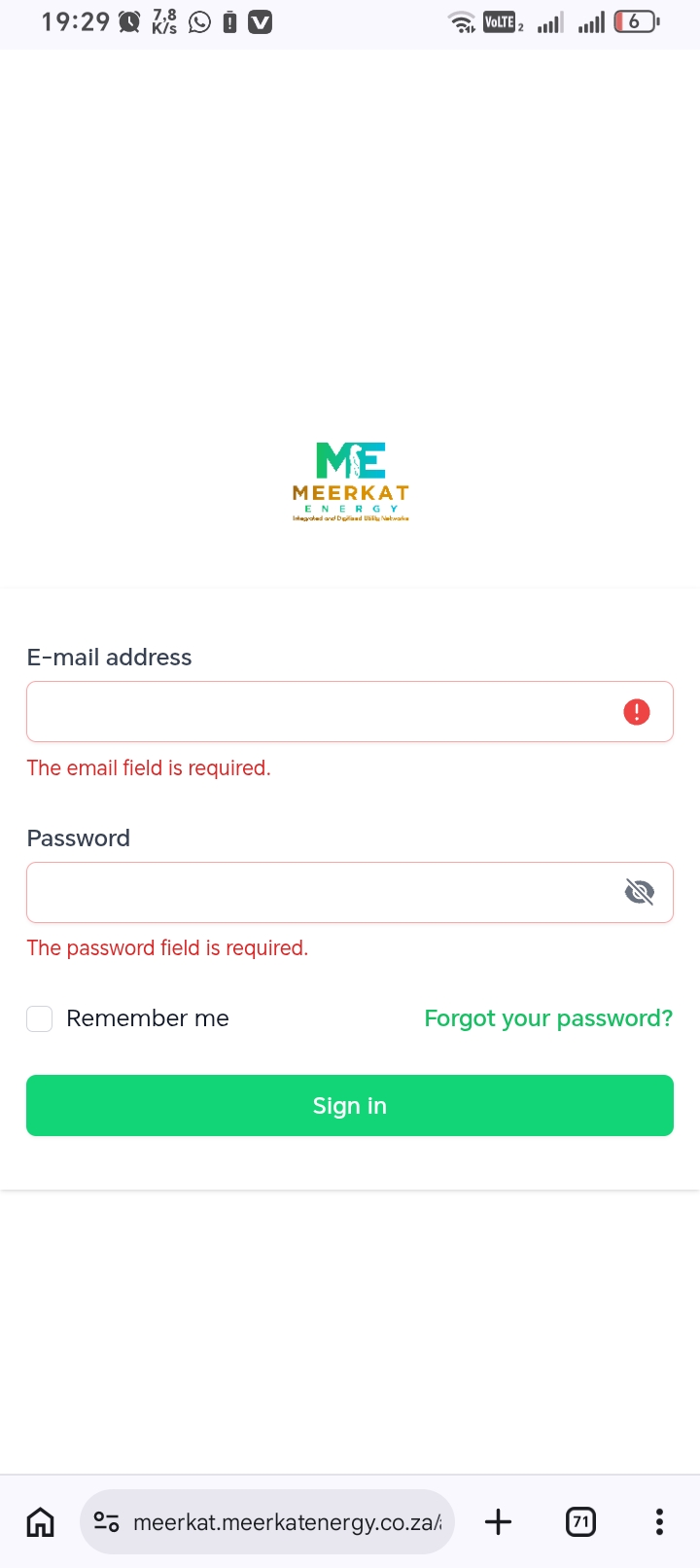
Evidence 4
login screen submitted with empty fields, correctly returning field-specific 'required' validation errors rather than a silent or generic failure. Supports the Existence & Accessibility finding that client-side validation is properly implemented
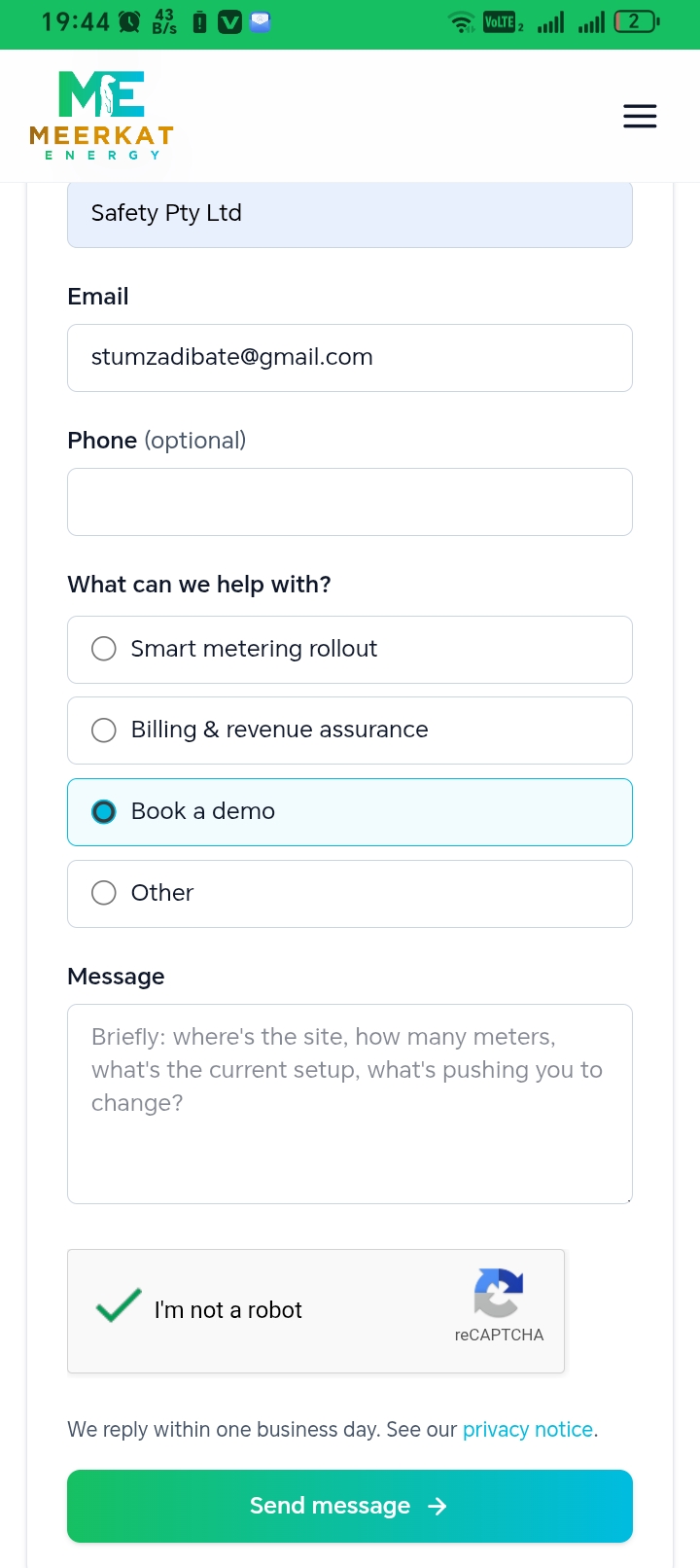
Evidence 5
Book a demo' contact form completed with reCAPTCHA verified, ready for submission. Supports the finding that required fields are enforced before the form can proceed
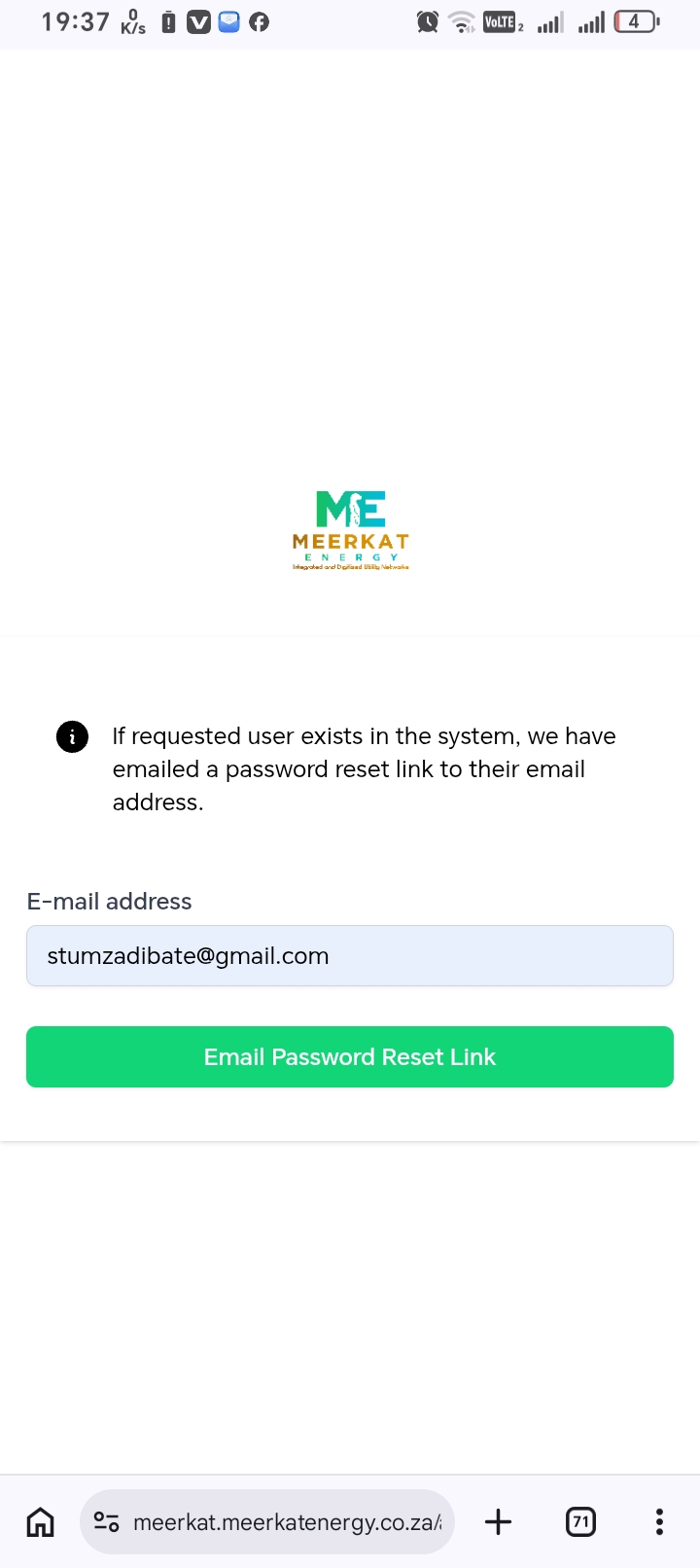
Evidence 6
forgot-password flow, showing an identical generic confirmation message regardless of whether the submitted email belongs to a real account. Supports the finding that the platform uses a privacy-conscious, user-enumeration-resistant password-reset pattern
Seven checkpoint assessment
The verified result is the official public checkpoint record. For earlier-standard reviews, these findings may have been reconstructed from preserved evidence during Sandbox Africa’s 2026 audit; they are not presented as if the contributor originally completed a structured worksheet. Contributor-submitted checkpoint wording is shown only where explicit public reviewer attribution has been enabled.
Step 1 — The Existence & Accessibility Check
Is it live?
Checking for dead links, infinite loading screens, or "Coming Soon" landing pages masquerading as live products.
Sandbox verifiedpass
meerkatenergy.co.za is live with a working customer login portal that correctly returns field-specific 'required' errors on empty submission, plus a privacy-conscious forgot-password flow (identical generic response whether or not the account exists). Separately, the 'Energy Insight' app (meerkatutilities.co.za, footer copyright iPay (Pty) Ltd, build v4.0.44.1) is a real, versioned production app — its meter-search function correctly rejected a test meter number with 'Unknown meter number or customer identifier,' confirming genuine backend validation
Onboarding friction
Can a user or enterprise actually sign up, or is it gated behind broken "Contact Sales" forms?
Sandbox verifiedpartial
The corporate site has no self-serve signup — new access is gated entirely behind a 'Book a demo' sales form, which blocked further testing as an unaffiliated user. The Energy Insight app, however, does offer genuine self-serve registration, though with gaps: invalid email/phone were accepted at signup with zero error feedback and simply failed to progress silently, and the meter-number field marked mandatory (red asterisk) was actually skippable
Step 2 — Functional Testing (The "Try It Out" Phase)
Core loop execution
Does the application actually do what it claims to do? (e.g. a payment gateway completing a test transaction, a logistics app's routing engine working.)
Sandbox verifiedpartial
On the Energy Insight app, the core loop — register, add/skip a meter, reach the 'My Meters' dashboard, search a meter number — worked end-to-end, with real backend validation on meter search. On the corporate site, the core loop (the metering/billing dashboard) could not be tested at all, blocked behind the sales-led demo request funnel
User experience (UX) & interface (UI)
Assessing the logical flow, responsiveness, and basic accessibility of the platform.
Sandbox verifiedpartial
Both surfaces are visually clean and professionally built with no broken screens. However, the app's registration step gives no feedback when invalid data is entered — it just doesn't proceed, with no indication why — which is a meaningful UX gap for an unguided first-time user
Step 3 — Technical & Architectural Assessment
Performance
Load speeds, uptime reliability, and basic stress responses.
Sandbox verifiedpass
Page loads and screen transitions on both the corporate site and the Energy Insight app were fast and responsive throughout testing, with no lag or timeout observed. Uptime reliability under sustained load could not be assessed from a single-session client-side test
Integration readiness
Availability, clarity, and functionality of API documentation and webhooks.
Sandbox verifiedpartial
No public API documentation, developer portal, or webhook references were found on either meerkatenergy.co.za or meerkatutilities.co.za during this session Editorial proposal adjusted from not_assessed to partial using current independent verification and the established gated-product/safety-critical rules.
Verification adjustmentSecurity basics
SSL certification, basic encryption standards, and data handling transparency.
Sandbox verifiedpartial
Positive: the forgot-password flow resists user enumeration by returning an identical response regardless of account existence — a deliberate, well-implemented security pattern. Negative: the Energy Insight registration form accepts invalid email and phone formats with no validation error shown at any point
Company right of reply
Claim company profile
Represent Meerkat Energy / Meerkat Utilities?
Claiming verifies company ownership and enables a response or additional evidence. It does not permit editing of the independent review.